NELIS’ DUTCH VILLAGE, Holland, MI – TULIPS and More

May 5, 2018

While visiting the Tulip Festival in Holland, Michigan,  an attraction that was high on my list  to see was Nelis’ Dutch Village.  Simply put –  I loved it!

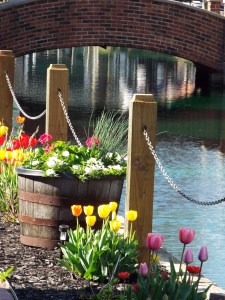
There were lots of blooming tulips, of course….

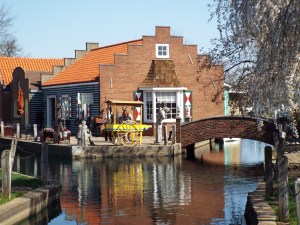
along with a  Dutch village  atmosphere complete with canals….


and wooden shoes…..

lots of wooden shoes…


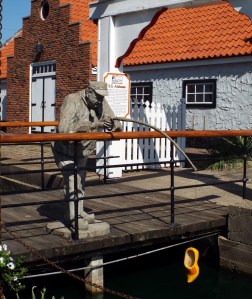
more canals….

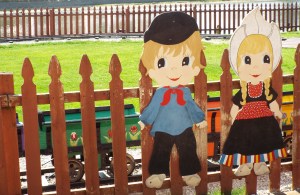
rides for the kiddos…

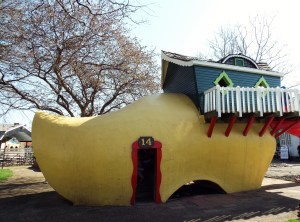
a playground, complete with a wooden shoe house playhouse and slide….

a petting zoo…

with ingenious  ways of feeding their baby lambs…

and grown up sheep also….

If you look closely underneath the trough, you will see baby ducklings.  Mama duck laid and  hatched her eggs in the straw there and the new  family  have made themselves right at home with the sheep.

All of nature was a bloom….

in all directions……


“Bread feeds the body, but flowers feed also the soul”  (unknown)

Hope you enjoyed!

Thanks for reading!

TULIP FESTIVAL, Holland, Michigan 2018

May 4, 2018

Prepare for tulip overload as I retrace my favorite  steps  from the 2018 Tulip Festival in Holland Michigan.  Holland  was  settled  by  Dutch immigrants  in  1847 and today  it is a beautiful, unbelievably clean town that was fun to visit and explore.

These are Blue Grape Hyacinths, smaller then the more common hyacinths but every bit as pretty.  I found these in plentiful supply along with the tulips and feel in love with them .

The breeze was picking up and the tulips danced.

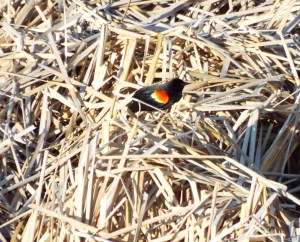
Bird of the day – the red-winged blackbird.

This being my first visit, I soon  realized  that  Michigan  has a  lot of marsh land.  Huge areas of  marsh grass are  dead and dried up in heaps from the winter now, but there are  small signs of regrowth.  These dead  heaps, however,  are  alive with bird activity and entertainment, especially from the red-winged blackbird and the purple martins.

Another part of nature I enjoy are interesting looking trees, or  more so in this case, creepy looking trees.

“In every walk with nature one receives far more than he seeks. ”   by John Muir

Hope you enjoyed!  Thanks for reading!


THE ORIOLES HAVE ARRIVED !!! MAY, 2018

May 3, 2018

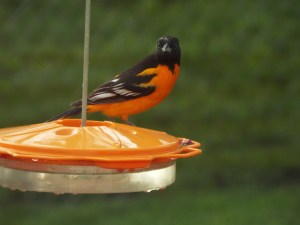
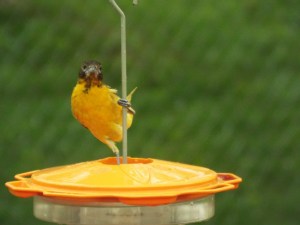
Right on time, the Baltimore Orioles   pass through Missouri and, if you tempt them with an ( orange) oriole feeder and some grape jelly, they may just visit your feeder – again and again and again.    I saw this pair today too many times to count.  I actually had to go outside and refill the grape jellies!   The  most vivid colors belong to the male, the other is the female.


Hope you enjoyed!

Thanks for reading!

COME SMELL THE HYACINTHS AND HEAR THE PURPLE MARTINS SING, SPRING 2018

April 28, 2018

It is finally spring and the Missouri Botanical Gardens is once again blooming with color and aroma.  I could smell the hyacinths   and hear the birds singing throughout the park .    If you are a tulip fan, you need to get to the park  soon, as about half of the tulips are already spent.  Here is a sample of what you can see…..


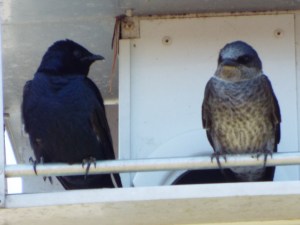
Bird of the day – Purple martins – who love the condo  life and to entertain the humans, and themselves, with activity and endless song.    The male is a dark purple color and the other a juvenile.   After watching and listening to them at the gardens, I realized I needed a purple martin house in my backyard.

Thanks for reading!

Happy Spring!!!!

ART IN BLOOM AT THE ST. LOUIS ART MUSEUM 2018

March 7, 2018

This past weekend was  Art In Bloom at the St. Louis Art Museum.  It is a yearly , free, event that  is interesting and enjoyable if you can tolerate  the heavy crowds and inadequate parking situation.  However, if you are member  of the Art Museum ( of which I am not) , there is a “members only” viewing time, which may help with the crowds and parking aggravations.   This year’s event had 40 floral arrangements that interpret various arts pieces in the museum.   It is, also, sort of  a “Where’s  Waldo?” set  up,  as you  have to walk the entire museum to see all the interpretations –  they are not all gathered together in one room.  I only saw about  half this year  so my photos  and opinions are limited to what I actually saw.

Let’s start with my favorite floral arrangement.

My favorite with the piece of art  that it  interprets.  Sorry, I have no names of the art pieces, the crowds made it difficult to move about and I was lucky ( some of the time) to get photos without stranger’s body parts in them.

Interesting…..

Love the painting

I liked this arrangement, though I could never figure out what it was matched with.

Though I am not fond of the twigs and sticks arrangement, I  do like how it fits with the painting.  Both pieces made me feel uncomfortable and out of my zone of appreciation.  I know not every piece of art is meant to be pretty, but the pretty one are my favorites.  : )

The above  two are paired together.

Lastly,  I was inspired enough to come home and create my own “art in bloom” .   Carnations  were purchased at Sam’s Club and  personally arranged.  The print was purchased at the Skagit Valley Tulip Festival in  the state of Washington – a wonderful trip  full of  colorful,  beautiful tulips  fields and can be found on my blog in the April 2012 archives).

Thanks for reading!

Gardenland Express 2017 – A HOLIDAY TRADITION

December 1,  2017

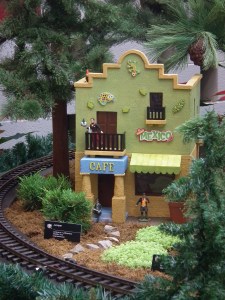
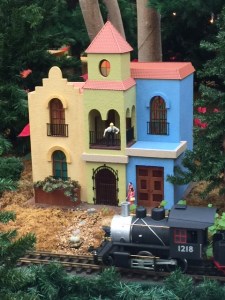
I have been going to the Missouri Botanical Gardens Gardenland Express train and flower show every Christmas  season for more years than I’d like to mention, but this last show  was definitely the best ever!   This posting is coming a bit late, but it was too wonderful not to share  my favorite bits and pieces.


There were also colorful and  beautifully  hand  embroidered  wall hangings to enjoy.


To make the day just a bit more magical, there was a soft snowfall that morning  that frosted the trees and bushes.

Thanks for reading!

Museum of Missouri Military History, Jefferson City, MO

July 23, 2017

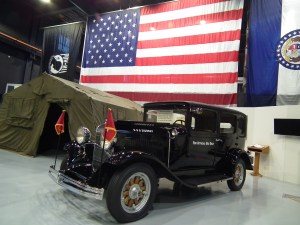
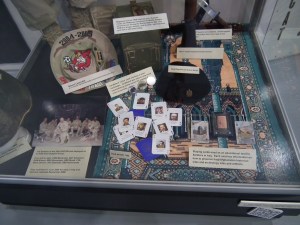
The Museum of Missouri Military History was the last stop of  the Jefferson City adventure.   Free, interesting and informative, the exhibits start with the 1808 founding of the MO Militia to today’s  National Guard.   There are  endless displays of the National Guard’s role in the Civil War, both World Wars, other conflicts and also humanitarian relief efforts.

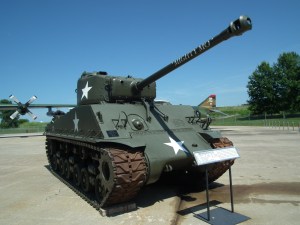
Outside was my favorite –  several decommissioned air craft, tanks, army vehicles and more.   Rosie’s Gang is a F4 Phantom II Supersonic  Jet – held 2 men and a huge collection  of armament.   It is  the original name of the plane of the crew to which  the F4  is dedicated.    On June 7th,  2003, the 157th Air Operations Group, Missouri National Guard dedicated the refurbished plane to Capt. Daffron and Major Morley.  Where did the jet get it’s name?    For the poignant story,  which steps back in time and hits home with reality,  read:

https://1973whsreunion.blogspot.com/2010/08/major-charles-f-morley-mia-kia-vietnam.html

WWII Sherman Tank – holds a crew of 5 and will go 25 – 30 miles per hour.

Bell AH1 Cobra  – an attack helicopter, holds 2 men and will fly 172 miles per hour.

Lockheed C-130A-LM Hercules,   4 engine turboprop,  holds an air crew of 5 men and most anything else you can dream up.  It was made for  transporting bulky equipment such as tanks and  artillery.  But it can  also slow down  to 143  miles per hour for paratrooper drops,  fly with 1 engine if needed  and land in tight spaces.  The Hercules has a long history of use in war, world-wide humanitarian crisis,  fire-fighting  seasons and can even  be equipped with skis and runners for snow and ice.   Guaranteed fascinating reading of  the history and events the Hercules has been needed and used for  since it was first built in the 1950’s.

Thanks for reading!

Hope you enjoyed!

The Colonel Alvin Lubker Memorial Safety and Educational Center


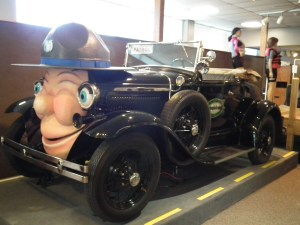
Otto the talking car.

July 23, 2017

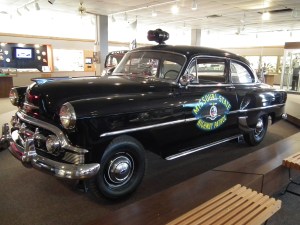
The Safety and Educational Center, free to all, was  a delightful  and interesting hour spent in Jefferson City, Missouri and home of Otto, the talking car.  Otto is a replica of  a 1931 Model A Ford Roadster, outfitted in 1969, with a giant cartoon State Trooper head.   36 Model A Ford Roadsters were assigned  to the State Highway Patrol in 1931 at a cost of $431.00 each.   Every vehicle  had 2 horns, a spotlight, a fire extinguisher, a first aid kit, and a lighted “PATROL” sign.  There were no sirens or heat and the Troopers were told to drive with the top down, weather permitting.

1942  Chevrolets, assigned to the Troopers were  the first to have “State Patrol “printed on the sides.   At that time, the US was in the midst of  WWII and few cars were being built.

Thus the Patrol cars were driven in excess of 100,000 miles and no parts were available for repairs.


Vintage Highway Patrol dispatch and communication command center.

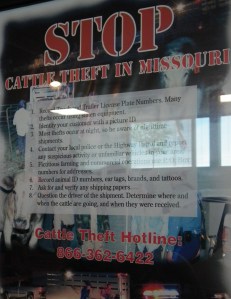
Cattle rustling is  still  a crime and still active today.

The museum also has  informational  displays regarding traffic and train safety, drinking and driving, the self destructive use drug abuse,  a few Bonnie and Clyde artifacts, a memorial wall  of the 31 troopers who died in the line of duty since 1931 when  the Mo State Highway Patrol was founded  and much more.  I highly recommend stopping by this museum if you are in the area.

Thanks for reading!

Hope you enjoyed!

Missouri State Penitentiary Museum

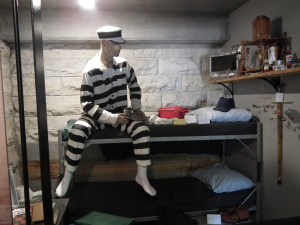
The last prisoner of the Missouri State Penitentiary  today now resides in the prison museum.

His attire displays the  striped prison outfits  that were fazed out in 1909.

July 23, 2017

The MO State Penitentiary  Museum is free to all and only requires about  a 30 minute stop.  Historical information and memorabilia of life inside the “walls”   pertaining to the 168 years the prison was in operation  can be found.

The Colonel Darwin  Marmaduke  House  was the warden’s residence, directly across the street from the prison.  This house  was  built in 1888, entirely by inmates  at a cost of $7000.  Prisoners also built  several other homes on the street.  The prison  museum is in the basement .

Interesting ideas can be found here.

Bench made by a prisoner to hide his shank.

This machine for inducing lethal injections replaced the gas chamber.  The buttons would need to be pushed by 2 different people. One set are dummy buttons.   That way the  2 people pushing the buttons would never know exactly which one gave the lethal injection.

Thanks for reading!

DOING TIME – MISSOURI STATE PENITENTIARY TOUR

168 years of history at the  Missouri State Penitentiary.

July 23, 2017

Touring an old prison may not be everyone’s  idea of an adventure, but I found it fascinating!  The Mo. State Penitentiary opened in Jefferson City, Missouri in  1836 and closed in 2004.    Nowadays, with advance reservations,   tours  of the remaining buildings and grounds are given , many times by men who has previously worked as guards at the prison.   Besides seeing the women and men’s cells, I saw  the showers,  the exercise yard,  solitary, death row, the hole ( cells where the  criminally insane lived ) and   the gas chamber.

If these walls could talk….
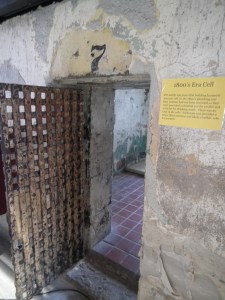
The  first and now oldest cell – each cell  housed 6 men with  a chamber pot, a bucket with drinking water, straw mattresses and no heat.

In 1842 the first women  prisoner arrived.   Having no place separate  to house women, she was soon released.

In 1893 the prison fed  and housed each inmate on 11 cents a day.

By 1900 there were 2200 prisoners.

In 1932  this prison was the largest in the country with 5200 inmates.

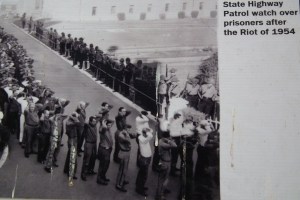
In 1954  the prison was national news due to rioting within the walls.

By 1967, Time magazine called this prison the bloodiest 47 acres  in Missouri.

Prisoners were very clever and sneaky.  They could turn  most anything into a shank ( a weapon).  Our guide told us of a previous inmate who came back to take a prison tour.  He recalled  to the guide where he had buried  some shanks on the grounds  when he was a prisoner.   The guide went to the spot and , sure enough, they found the buried shanks, some of which are displayed on this board.
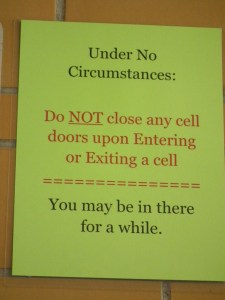
As Forrest Gump’s Mom said – “You can’t fix stupid.”

As a reminder to the  tourists not to be stupid –  warnings  are posted everywhere  not to close a cell door behind you.   Still, our guide explained, there are people who do it anyway and get locked in the cells.  The doors  were designed to  lock  when closed.  Over the years the hardware has  rusted and / or been damaged and may not open so easily.  He said some persons have had to wait up to 2 and 1/2 hours  for  help to get them out.
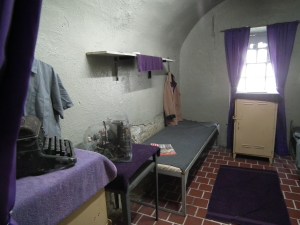
In certain areas,  prisoners were allowed  to paint and  ” decorate” their cells for that “more homey” feel.
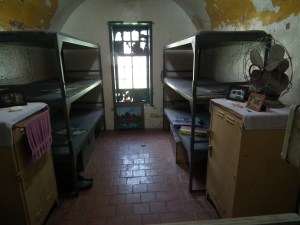
Cells were built to  house 2 prisoners.  But as the years went on and the prison became more crowded,  the cells would hold 6.

Razor wire topped  the prison ground  walls to deter any ideas of climbing toward freedom.

If you happen to be a prisoner on suicide watch – you get a concrete bunk.

Mike was a stray cat who found a way onto the prison grounds and  lived out the rest of his years there.  Mike  would make his  predictable  daily  rounds collecting treats that  prisoners saved for him.   One prisoner  made a ” back pack”  of sorts for Mike and put cigarettes in it to be delivered to other inmates.
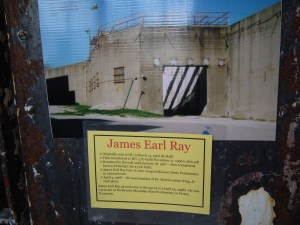
There were several note worthy prisoners who resided  at this Missouri  prison.  To name a few –   Pretty Boy Floyd  arrived in 1925 for  robbery,  Sonny Liston  in 1950  for robbery and larceny.  Liston learned to box in prison and after being paroled, he went on to  win the National Heavyweight Championship in Chicago in 1953.   James Earl Ray  arrived in  1959 after  robbing a St. Louis Kroger store.  In 1967, Ray escaped from the prison by hiding in a bread  box that was loaded onto a truck and left the grounds.  Nearly a year later , on Thursday, April 4, 1968, Ray assassinated Martin Luther King, Jr. in Memphis, Tennessee.

In 1954  prisoners rioted and  burned many buildings with in the prison walls.  Almost  2,500 rioters were on the loose inside the walls.  Highway patrol troopers, Kansas City and St. Louis police, national guardsmen and local police were called to the scene.  Troopers later stormed the grounds to gain control.  In the end, , four inmates had been killed, and 50 injured.  Only four officers had been injured.   Damage was estimated to be as much  as $5 million dollars.
For a fitting end  ( of this posting) – between 1937 and  1989,  40 inmates  were put to death in  the  gas chamber.  After that  all capital punishment inmates were moved to the new prison at Potosi. 

Thanks for reading!  Hope  you found this interesting!

I also visited the Missouri State Penitentiary Museum , the Colonel Alvin Lubker Memorial Safety and Educational Center and the Museum of Missouri Military History on that quick trip to Jefferson City.  All museums were free!   Watch for those postings to follow.
Previous Older Entries Next Newer Entries